The Doorbell’s Mains Secret: Will Your Transformer Carry a Smart Bell Through Winter?

Photo by Photo by Call Me Fred on Unsplash on Unsplash
By mid-November, the doorbell camera is doing overtime: dark afternoons, delivery drivers in hoods, and a Wi-Fi signal that has to push through a closed front door. Most people buying a video doorbell check the app, the subscription and the night-vision specs. Very few check the little transformer that has been quietly humming near the consumer unit since the house was wired for a dumb bell.
That transformer is the boring bit that decides whether your shiny wired doorbell actually works in February. A wired smart doorbell does not run on mains magic. It trickle-charges an internal battery, and if the transformer is too small, too old or the wrong voltage, the battery slowly loses the argument—especially in cold weather when the camera wakes up more often and the battery is less keen to accept charge.
Where the little box tends to hide
In UK homes, doorbell transformers turn up in some genuinely annoying places. Sometimes they are clipped next to the consumer unit. Sometimes they are inside the chime box in the hallway. Sometimes they are in the airing cupboard, a cupboard under the stairs, or screwed to a joist in the loft. Older ones may be marked 8V, 12V or 16V AC, with a VA rating stamped somewhere tiny.
If you cannot find it, do not start pulling up floorboards. Check around the chime first, then the area near the consumer unit. Some modern chimes have the transformer built in. If your house has only ever had a battery doorbell, there may be no transformer at all—and that changes the job from ‘plug in a new bell’ to ‘install a low-voltage supply’.
Voltage and VA: both matter, and one is usually ignored
Voltage is the easy bit. The doorbell’s manual will state something like 8–24V AC, or 16–24V AC. Too low and the bell may not charge or may drop off the network. Too high and you risk damaging it, overheating the transformer or shortening the battery’s life. Do not assume ‘more volts equals more better’.
The VA rating is the part people skip. VA stands for volt-amperes, and for a small AC transformer it is a rough measure of how much current it can supply. A 16V transformer rated at 10VA can theoretically deliver about 0.6A. A 16V unit rated at 30VA can manage nearly 1.9A. Smart doorbells often want a transformer in the 16–24V, 10–40VA range, but check your model’s exact wording. An old 8V, 5VA transformer from a basic ding-dong chime is usually not going to cut it.
There is also voltage drop. Bell wire is thin, and a long run from transformer to doorbell can lose volts. A transformer reading 16V at the consumer unit might deliver only 12V at the bell. If the doorbell is marginal on voltage, that difference matters.
Testing it without turning yourself into a statistic
The mains side of a transformer is not a DIY playground. If you are not confident working around fixed wiring, stop and book an electrician. That is not defeatism; it is cheaper than a funeral.
If you are competent, isolate the correct circuit at the consumer unit, lock it off, and prove dead with a proper tester before touching anything. Do not trust a light switch or a fused spur to be the last word. Once the mains side is safely isolated, read the transformer label with a torch or phone camera. Note the input voltage, output voltage and VA rating.
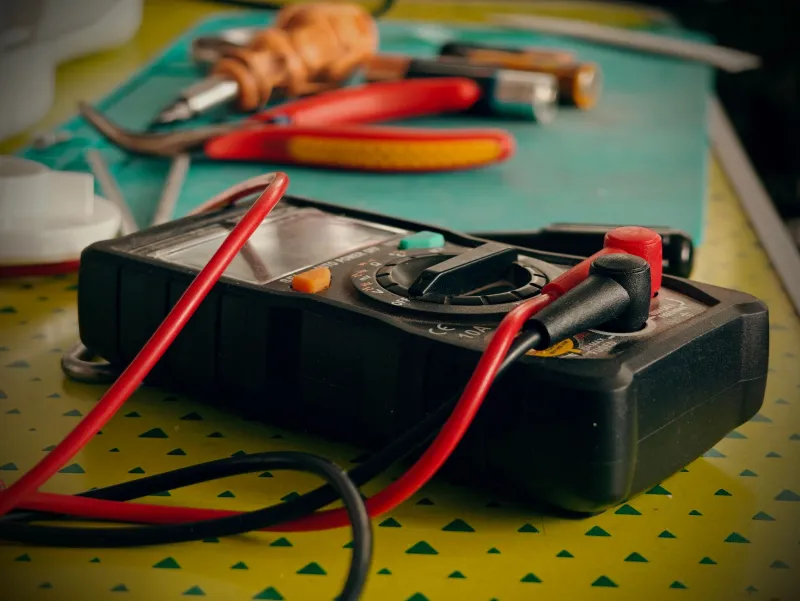
If the label is missing, you can measure the low-voltage output with a multimeter set to AC volts, across the secondary terminals. Expect something near the nominal figure—often a bit higher with no load. Do not unscrew covers to probe the primary side. If the transformer needs replacing, use a qualified electrician. A like-for-like swap may sound simple, but it is still mains work inside or next to the consumer unit.
The chime bypass is part of the bill
Wired doorbells often need a power kit or bypass fitted at the existing chime. This stops the chime buzzing, lets enough current reach the doorbell, and keeps the whole setup stable. Some doorbells include the bypass in the box; some do not. If you have a mechanical chime, check compatibility. If you have a digital chime, check again—some smart doorbells do not play nicely with them.
This is the hidden cost people forget. It is not just the transformer. It is the transformer, the bypass, the electrician’s callout and the hour spent working out which breaker feeds the hallway. If you rent, add ‘ask the landlord’ to the list.
A winter reality check
Cold weather is hard on lithium cells. A doorbell battery that copes in July can look tired in January, and a camera that triggers more often at night has less spare energy for charging. If the transformer is undersized, the battery never really recovers. You end up with a smart doorbell that is smart for three weeks and then just a expensive plastic plaque.
Before you blame the doorbell, check the supply. Look at the battery percentage in the app over a week. If it falls steadily while the bell is wired, the transformer or wiring is suspect. Shortening clip length and reducing motion sensitivity can buy time, but it is not a fix.
The buying checklist
Before ordering a wired video doorbell, find the transformer, note its voltage and VA rating, and compare them with the doorbell’s manual. Add headroom for the chime and the camera. Measure the wire run if you can. Budget for a bypass and, realistically, an electrician. If there is no transformer, decide whether you want a battery model or a proper install.
A £25 transformer is not the exciting part of a doorbell upgrade. It is, however, the part that decides whether the thing still answers the door in February. Check it before you buy—not after the first cold snap.